

You walk out to your flowerbeds on a crisp morning, expecting to see the first shoots of your prize tulips, only to find a series of raised, spongy ridges across the lawn and empty holes where your bulbs once sat. It’s a frustrating sight for any gardener who values a tidy space, yet many of us feel a deep conflict when it comes to dealing with the culprit. The vole animal is a small, prolific creature that can reach densities of up to 4,000 per acre during peak population cycles, making their impact on your garden feel overwhelming.
We understand the desire to maintain a beautiful garden whilst respecting the local ecosystem. You don't need to resort to cruel traps or toxic poisons that could harm owls or family pets. In this guide, I'll share my experience in identifying these elusive rodents and provide practical, non-lethal strategies to safeguard your plants. We'll explore how simple habitat changes and ethical scent-based deterrents like Revira can restore balance to your outdoor space, giving you peace of mind and a flourishing garden.
Key Takeaways
- Identify the vole animal by its blunt snout and short tail to distinguish it from the common wood mouse.
- Understand the "vole clock" phenomenon to better prepare for sudden surges in activity across your flowerbeds.
- Discover why habitat modification is a more sustainable, long-term solution than the cycle of traditional trapping.
- Adopt the mindset of an ethical guardian to protect your bulbs whilst maintaining a balanced garden ecosystem.
- Learn how scent-based deterrents like Revira encourage voles to relocate humanely by mimicking natural predator cues.
Identifying the Vole: More Than Just a "Field Mouse"
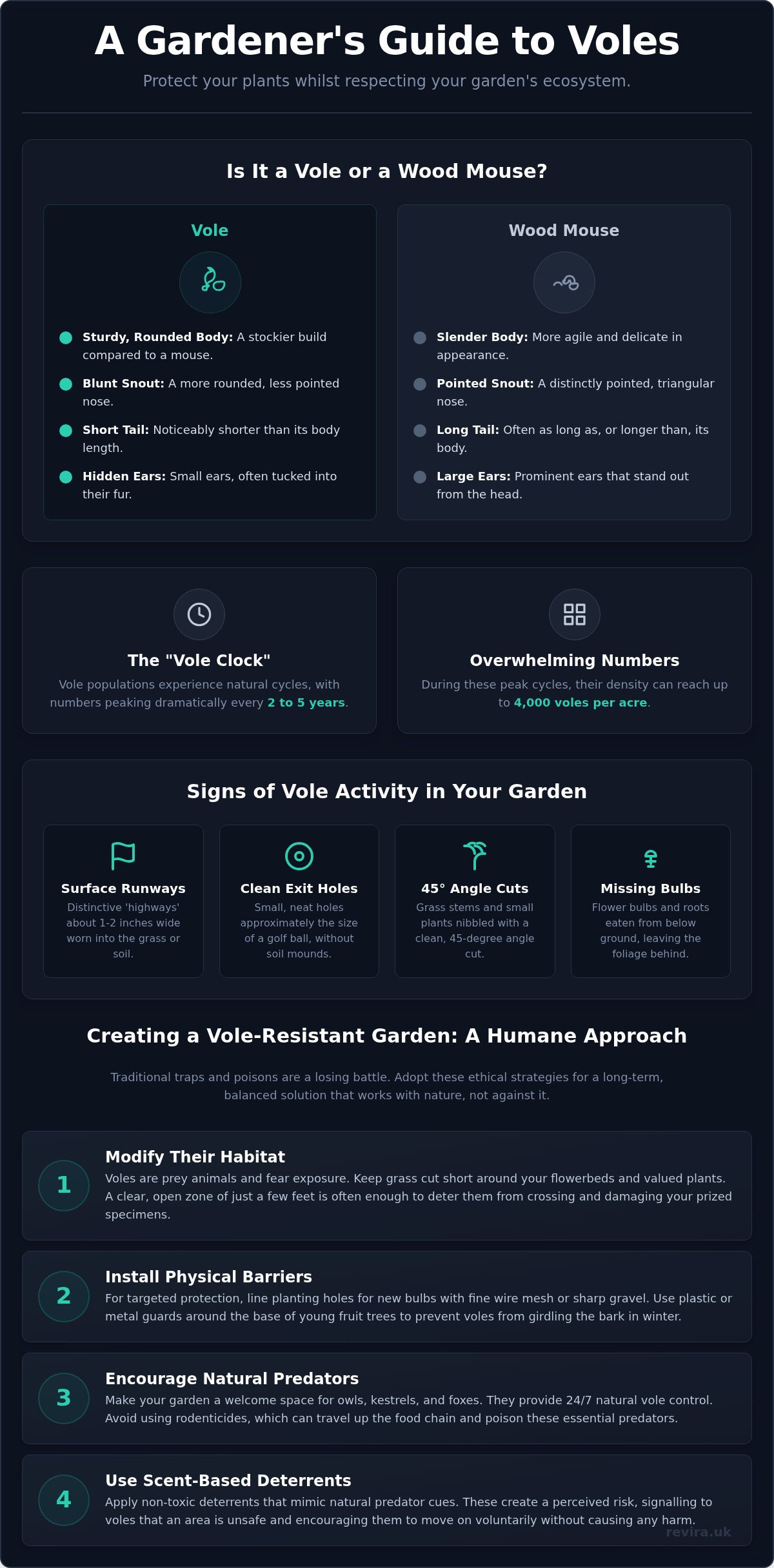
The vole animal is often misidentified as a common wood mouse, but a quick look at its physical features tells a different story. Unlike the long-tailed, large-eared wood mouse, a vole has a much sturdier, rounded body. Its snout is blunt rather than pointed, and its ears are almost entirely tucked into its fur. The most telling sign is the tail; it's noticeably shorter than its body length, usually less than half the length of the animal itself.
You might find your garden suddenly teeming with activity after years of quiet. This is due to the "vole clock," a natural population cycle where numbers peak every two to five years. During these irruptions, densities can reach as high as 4,000 per acre. Whilst they can be frustrating for a gardener, the vole animal is a vital keystone species. They provide a primary food source for owls, kestrels, and foxes. Maintaining a garden ecosystem where they exist without causing destruction is better than attempting total eradication.
Field Vole vs Bank Vole: Which One Is in Your Garden?
If your lawn is covered in narrow, grass-roofed tunnels, you likely have field voles. They prefer tussocky grass for cover and have tails roughly a third of their body length. Bank voles, however, are more likely to be found amongst your shrubs and hedges. They have slightly longer tails and a richer, reddish-brown coat. Knowing which species you're hosting helps you decide where to focus your protection efforts, as their habits dictate where they'll most likely feed.
Signs of Activity: Tunnels, Runways, and Nibbled Bulbs
Vole damage is quite specific. Look for surface runways, which are little "highways" worn into the grass or soil. Unlike moles, which leave large mounds of earth, voles leave small, clean holes about the size of a golf ball. If you find nibbled grass stems, look closely at the ends. Voles leave a distinct 45-degree cut, as if they’ve used tiny garden shears. They’ll also target flower bulbs from below, often leaving the top of the plant intact whilst the root system vanishes.
Assessing the Damage and Natural Deterrence Strategies
Seeing vole damage in your garden often triggers an immediate urge to reach for traps or poisons. However, traditional extermination is a losing battle. The vole animal is a prolific breeder, capable of producing multiple litters each year with as many as eleven young per litter. If you remove one population, the empty territory is quickly claimed by another. Instead of a cycle of conflict, I recommend making your garden less attractive to them through strategic habitat changes.
Habitat modification is your strongest tool. Voles are naturally cautious because they're a favourite snack for predators. By keeping grass shorter around your prize specimens, you remove the protective cover they need to feel safe. A clear zone of just a few feet can be enough to discourage them from venturing toward your most valued plants. You're essentially using their natural fear of exposure to guide them away from your flowerbeds.
Protecting Your Lawn and Ornamental Plants
Physical protection offers immediate results for specific plants. When planting new bulbs, consider lining the hole with a fine wire mesh or adding a layer of sharp gravel. These textures are uncomfortable for a vole animal to tunnel through. For young fruit trees, use plastic or wire guards around the base of the trunk. This prevents girdling, where the animal nibbles the bark in winter, a behaviour that can eventually kill the tree by cutting off its nutrient supply.
The Role of Natural Predators in Your Garden
A healthy garden ecosystem includes predators. Encouraging owls and kestrels provides 24-hour monitoring that no trap can match. Using rodenticides is a dangerous path; these toxins accumulate in the rodent's system and can kill the very birds of prey you want to attract. Protecting your space naturally keeps the environment safe for the broader food chain. For those seeking an extra layer of security, exploring humane scent-based protection can help reinforce these boundaries without risk to local wildlife.
Creating a Vole-Resistant Garden Without Poisons or Traps
Managing a garden involves more than just planting and weeding; it’s about acting as an ethical guardian for the wildlife that visits. When you encounter a vole animal, your first instinct might be to reach for a quick fix. However, shifting your perspective towards deterrence creates a more stable environment. By using methods that encourage animals to move on voluntarily, you avoid the messy, often ineffective cycle of lethal control. This approach respects the creature’s role in the food chain whilst ensuring your favourite flowerbeds remain untouched.
Why Deterrence Beats Traditional Pest Control
Lethal traps and poisons are often temporary solutions that ignore the root of the problem. Because voles breed so rapidly, a vacant tunnel system is usually reoccupied within weeks. Non-lethal intervention focuses on making the area fundamentally unattractive. This preserves the local biodiversity and ensures that your garden remains a safe haven for beneficial insects and birds. It’s a cleaner, more sophisticated way to manage your outdoor space without the ethical burden of harming the local fauna.
Implementing a Scent-Based Barrier
One of the most effective ways to redirect the vole animal is through scent-based discouragement. Products like Revira use specialised granules that mimic the scent of natural predators. When a vole detects these cues, its instinct for survival overrides its desire to feed on your bulbs. You should apply these granules around the perimeter of vulnerable areas, such as vegetable patches or prize ornamental borders. This creates a clear boundary that the animals learn to avoid.
This method is particularly beneficial for households with dogs, cats, or young children. Since the granules are non-toxic and don't rely on harmful chemicals, you can maintain your garden’s protection with complete peace of mind. For the best results, consult our frequently asked questions to understand how to maintain the barrier throughout the seasons. A consistent application ensures that the message to stay away remains clear and effective all year round, providing a long-term plan that balances a tidy garden with a healthy ecosystem.
Cultivating a Balanced Garden Ecosystem
Protecting your flowerbeds doesn't have to mean declaring war on local wildlife. By learning to identify the vole animal by its unique physical traits and feeding habits, you've already taken the most important step toward effective management. Practical changes, like keeping grass short near vulnerable plants and installing physical guards for young trees, significantly reduce damage without resorting to lethal methods.
These adjustments, combined with a respect for the natural food chain, ensure that your garden remains a healthy space for everyone. You don't need to risk the safety of pets or beneficial predators like owls with toxic baits. Instead, you can rely on proven, scent-based solutions that work with nature rather than against it. It's about finding that middle ground where your prize tulips thrive alongside the creatures that call your garden home.
If you're ready to secure your borders without compromising your values, discover our humane vole deterrent granules. Our non-toxic, poison-free technology is trusted by UK gardeners who prioritise ethical wildlife management. It's a simple, effective way to reclaim your peace of mind whilst keeping the local ecosystem in perfect harmony.
Frequently Asked Questions
How can I tell the difference between a vole and a mouse in my garden?
You can distinguish a vole from a mouse by looking at the tail and snout. A vole animal has a much shorter tail, usually less than half its body length, whilst a mouse’s tail is at least as long as its body. Voles also have rounded, blunt faces and ears that are largely hidden by their fur. In contrast, mice have prominent, large ears and a more pointed snout that gives them a triangular facial profile.
Do voles cause significant damage to UK lawns and plants?
Voles can cause noticeable damage, particularly during winter when other food sources are scarce. They often nibble the bark at the base of young trees, a process known as girdling, which can eventually kill the plant. You might also notice surface runways through your lawn or find that your flower bulbs have been eaten from underground. Whilst the damage is frustrating, it's usually concentrated on specific plant types rather than total garden destruction.
Is it possible to get rid of voles humanely without using traps?
Yes, you can encourage voles to leave your garden humanely by making the environment less hospitable. Habitat modification, such as keeping your grass shorter and clearing away thick mulch, removes the protective cover they need to feel safe from predators. Combining this with scent-based deterrents provides a clear signal that the area is no longer safe. This approach is more sustainable than trapping because it addresses the reasons why the animals were attracted to your garden initially.
Are vole deterrents safe to use around my pets and local wildlife?
Natural scent-based deterrents are entirely safe for your pets, children, and the broader ecosystem. Unlike traditional poisons, which can lead to secondary poisoning in owls and kestrels, these granules rely on natural scent signals to discourage the vole animal from entering a specific area. This ensures that your garden remains a healthy, chemical-free environment for your family whilst still providing effective protection for your ornamental plants and prize bulbs.