

Imagine stepping out with your morning coffee only to find your pristine lawn resembles a miniature battlefield, scarred by deep snuffle holes and uprooted flowerbeds. It is a common frustration for UK gardeners, yet many feel trapped between the desire for a beautiful garden and the legal responsibility to protect these iconic mammals. Finding an effective badger deterrent that actually works without causing harm can feel like an impossible task, especially after wasting money on ultrasonic devices that the local wildlife simply ignores.
We understand that you want to reclaim your outdoor space whilst remaining a conscientious guardian of the environment. You shouldn't have to choose between a healthy lawn and the safety of species protected under the Protection of Badgers Act 1992. This guide will show you how to ethically discourage badgers from your property using proven, non-toxic methods that are safe for your pets and the local ecosystem. We will explore the science of scent-based discouragement and provide a step-by-step approach to maintaining a garden that stays beautiful and badger-free for the long term.
Key Takeaways
- Learn to identify specific signs of activity, such as cone-shaped snuffle holes and boundary latrines, to confirm if badgers are visiting your garden.
- Discover why common solutions like ultrasonic devices and standard fencing often fail to provide a reliable, long-term badger deterrent.
- Compare the efficacy and environmental impact of different methods, focusing on the ease of applying natural granules versus installing complex physical barriers.
- Master a methodical application process that targets active digging zones and entry points to discourage foraging without causing harm.
- Find out how to protect your lawn whilst maintaining a safe environment for your pets and local wildlife using non-toxic, clay-based technology.
Identifying the Problem: Is a Badger Visiting Your Garden?
Before you can select an effective badger deterrent, you must be certain of your visitor. The European badger is a creature of habit; it follows the same routes and foraging patterns night after night. Most gardeners first notice "snuffle holes". These are shallow, cone-shaped pits in the turf where a badger has used its powerful snout to probe for earthworms and leatherjackets. Unlike the random scratching of a dog, these holes are often grouped together in specific areas of the lawn where the ground is softest.
Look closer at your boundaries for more definitive evidence. Badgers are tidy animals in one specific regard: they use communal toilets called latrines. These are small, shallow pits, usually found near the edge of a garden or along a well-used path. You might also spot "runs", which are flattened trails through long grass or gaps under fences where the badger's heavy body has pushed through vegetation. These signs confirm a resident population rather than a passing visitor. Identifying these specific entry points is essential for targeted protection.
The Legal Landscape of Badger Protection
In the UK, badgers are among the most protected species. The Protection of Badgers Act 1992 makes it a serious criminal offence to kill, injure, or take a badger. It's also illegal to interfere with a badger sett, even if it appears empty. This legal framework is why choosing a humane badger deterrent is vital for any homeowner. Ethical deterrence focuses on scent and taste discouragement; it guides the badger away from your prize flowerbeds without causing physical distress or breaking the law. Repelling is about changing the animal's choice, not causing it harm.
Signs of Damage vs. Healthy Activity
It's easy to blame badgers for every hole, but other wildlife can be equally busy. Squirrels typically dig small, neat holes just large enough to hide a nut; they don't leave the wide, conical depressions typical of a badger. Foxes often dig more aggressively, leaving larger, messier mounds of soil, often accompanied by a distinct, pungent musk. Badgers are methodical foragers. They target specific areas like damp lawns or recently planted bulb beds where high concentrations of grubs or larvae reside. Understanding this territorial marking and feeding behaviour allows you to apply solutions exactly where they are needed most.
Why Traditional Deterrents Often Fail
Many gardeners turn to high-tech gadgets or heavy-duty fencing at the first sign of a snuffle hole. While these options seem logical, they often ignore the biological reality of the animal. Most temporary solutions fail because they don't address the fundamental reason a badger enters your garden: its powerful, scent-driven instinct to forage and defend territory.
Ultrasonic devices are a popular choice, but they rarely provide a permanent solution. Badgers are intelligent; they quickly realise that the high-pitched noise isn't followed by a physical threat. This process is known as habituation. Once the animal understands the sound is harmless, the device becomes background noise. Additionally, "sound shadows" created by garden structures like sheds or thick hedges mean the sound doesn't reach every corner, leaving easy paths for a visitor to follow.
Scare tactics like motion-activated lights or solar-powered "predator eyes" suffer from the same problem. They might startle a badger for a night or two, but the effect is fleeting. Once the badger discovers that the "eyes" don't move and the lights don't bite, it will return to its favourite feeding spots. Relying on these mechanical methods often leads to a cycle of wasted investment and continued garden damage.
The Science of Badger Scent Marking
Badgers navigate their world through an incredibly sophisticated sense of smell. They live in social clans and use scent from specialised glands to mark the boundaries of their territory. This "scent map" tells the badger where it is safe to forage and where it must defend its ground. If your garden is part of an established run, a badger's instinct to follow that path is remarkably persistent. Traditional deterrents that focus only on sight or sound fail to disrupt this olfactory navigation. To be effective, a badger deterrent needs to interfere with these territorial signals, making the area smell "wrong" or uninviting to the animal's sensitive nose.
The Limitations of Mechanical Solutions
Physical barriers like fencing can be effective, but only if they are installed with extreme precision. Badgers are powerful diggers. They can easily undermine a standard garden fence in minutes. For a barrier to work, it must be buried at least 0.5 metres deep and constructed from heavy-gauge mesh. This is often expensive and can spoil the aesthetic of a well-tended garden. It's also worth noting that more drastic measures, such as traps or poisons, are strictly illegal under UK law. When looking for humane badger deterrents, gardeners should prioritise methods that work with the animal's biology rather than against it. If you're tired of repairing your lawn, using scent-based granules can provide a more discreet and ethical way to protect your space.
Comparing Badger Deterrent Methods: Granules vs. Barriers
Deciding on the best approach for your garden often involves balancing efficacy with ease of use. For many, the choice lies between scent-based granules and physical exclusion. Whilst heavy-duty fencing is a traditional recommendation, it is rarely the most practical or cost-effective option for a standard residential plot. Scent-based solutions offer a more flexible badger deterrent that respects the natural layout of your outdoor space.
Granules are particularly advantageous for large or irregularly shaped gardens where fencing would be prohibitively expensive. They allow for targeted application around specific "hotspots" like prize bulb beds or vulnerable lawn sections. This methodical approach is often more sustainable than blanket chemical sprays, which can leach into the soil and require frequent reapplication after every rain shower. When you choose a scent-based solution, you're opting for a discreet intervention that doesn't require planning permission or a major garden overhaul.
Non-Toxic Granules: The Scent-Based Advantage
Specialised clay-based granules provide a sophisticated way to manage wildlife behaviour. These granules are designed to hold scent for extended periods, even in damp conditions. Unlike liquid repellents that quickly evaporate or run off, the clay acts as a slow-release carrier. This ensures the deterrent remains active for weeks rather than days. Because these products are non-toxic, they are entirely safe for your pets and the garden birds that visit your lawn. You can maintain a pristine environment without introducing harsh synthetic chemicals into your local ecosystem. It's a grounded, ethical choice for the modern gardener.
Physical Barriers and Habitat Modification
If you choose to use physical barriers, they must be installed correctly to be effective. A simple wooden fence won't stop a badger; they can easily dig underneath or even push through weak points. Expert guidance on Badger Damage Prevention and Control suggests that mesh must be buried at least 50 centimetres deep to be truly badger-proof. This is a significant undertaking that requires both time and physical labour. For many, the aesthetic impact of such heavy-duty fencing is a major drawback.
A more holistic approach involves habitat modification alongside your chosen deterrent. Removing fallen fruit, securing bird feeders, and ensuring compost bins are inaccessible reduces the reasons for a badger to visit. Integrating wildlife deterrents for gardens into your maintenance routine creates layers of protection. This strategy is often more successful than relying on a single method, as it addresses both the animal's hunger and its territorial instincts without compromising the beauty of your garden.
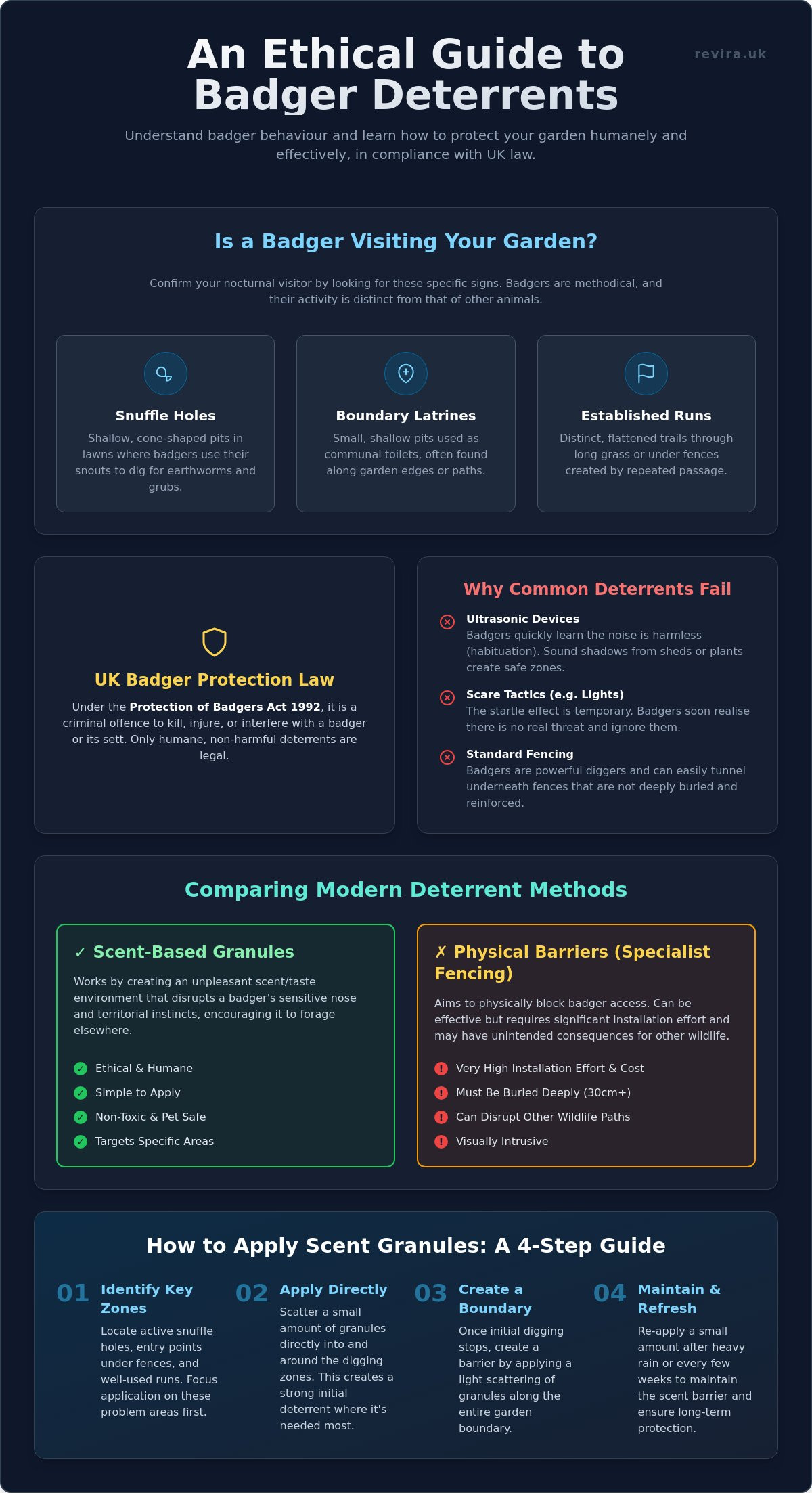
How to Apply Badger Deterrent Granules: A Step-by-Step Guide
Applying a badger deterrent effectively is less about building a physical wall and more about creating a psychological one. Success depends on a methodical approach that respects the animal's biology. If you follow these steps, you can guide badgers away from your garden without causing them any distress.
- Step 1: Identify entry points and active digging zones. Walk your perimeter at dusk. Look for those flattened paths through the hedge or gaps under the gate. These are your primary application zones. Focus on areas where you have seen recent snuffle holes or latrines.
- Step 2: Clear the area of existing debris and food sources. Badgers have an incredible sense of smell. If they can detect fallen fruit, spilled bird seed, or accessible compost, their motivation to enter will outweigh their caution. Tidy these areas before applying your deterrent.
- Step 3: Apply granules along boundaries and around vulnerable beds. Create a "scent fence" by scattering granules along the paths the badgers use to enter. You should also create a protective ring around specific areas, such as your lawn or vegetable patches.
- Step 4: Monitor and reapply according to weather conditions. Check your garden daily for new activity. If the badgers attempt a new route, adjust your application accordingly. Consistency is the key to changing their long-term behaviour.
If you are ready to reclaim your lawn, you can buy our specialised badger deterrent granules here to start your garden's transformation.
Timing and Weather Considerations
The best time to apply your granules is in the early evening, just before badgers emerge from their setts to forage. This ensures the scent is at its most potent when they first encounter your boundary. Whilst our clay-based granules are designed to be durable, the famously wet British weather can eventually diminish their efficacy. After a period of heavy or prolonged rain, a light "top-up" application will maintain the strength of the scent barrier. You may also notice a peak in activity during the spring and autumn when badgers are most active; be prepared to monitor your garden more closely during these months.
Strategic Placement for Territorial Disruption
Effective placement is about disrupting the badger's established "map" of your garden. By placing granules exactly where they cross your boundary, you create a clear signal that the territory has changed. This approach is far more effective than scattering them randomly across the lawn. You can also use these granules as a mice rodent repellent, providing dual protection for your flower bulbs and vegetable roots. This multi-species strategy ensures your garden remains a peaceful, undisturbed space for you and your pets to enjoy.
Choosing an Ethical Solution: The Revira Difference
Selecting an ethical badger deterrent is about more than just protecting your turf; it is about respecting the wildlife that shares our environment. As we move through 2026, the shift away from aggressive intervention toward gentle discouragement has become the standard for responsible UK gardeners. Our specialised clay-based granules represent this modern approach. They provide a sophisticated alternative to household "remedies" like bleach or diesel, which are not only ineffective but also illegal and harmful to the soil.
Safety is a cornerstone of the Revira philosophy. Because our granules are non-toxic and derived from natural origins, they are completely safe for your cats, dogs, and the garden birds that forage on your lawn. Unlike traditional chemical sprays that can wash away and contaminate groundwater, the clay structure ensures the scent remains stable and localized. This longevity means fewer applications and a more dependable barrier for your garden boundaries. It is a solution that values the well-being of your pets whilst maintaining the integrity of your local ecosystem.
A Conscientious Approach to Garden Protection
Our approach focuses on discouragement rather than harassment. By disrupting the badger's scent-map, we guide the animal to forage elsewhere without causing it physical distress. This supports local biodiversity by allowing badgers to exist in the wider landscape whilst keeping your private space undisturbed. Many homeowners find that adopting a similar deer repellent strategy for larger visitors creates a comprehensive, humane shield for the entire property. It is about creating a garden that thrives in harmony with nature, not in conflict with it.
Practical Tips for Long-Term Success
Integrating badger deterrent granules into your regular garden maintenance is simple and efficient. For the best results, make a quick perimeter check part of your weekly routine, especially during the active spring and autumn months. You will know your strategy is working when you see fewer snuffle holes and notice that old "runs" or paths through your vegetation begin to grow over.
Revira remains the preferred choice for ethical gardeners because we offer a proven, stable solution that doesn't compromise on values. By choosing a product designed for durability and safety, you are investing in the long-term health of your garden. You can enjoy a pristine lawn and vibrant flowerbeds whilst fulfilling your role as a conscientious guardian of the British countryside.
Reclaiming Your Garden Whilst Protecting Local Wildlife
Protecting your garden doesn't mean waging war on the natural world. It's about being a conscientious guardian of your space. By accurately identifying signs of activity and choosing scent-based disruption over flawed mechanical devices, you can achieve lasting results. A well-applied badger deterrent respects the animal's biology whilst ensuring your lawn remains pristine and undisturbed.
If you're looking for a solution that's non-toxic, safe for pets, and specially formulated for UK wildlife behaviour, our clay-based granules offer a dependable path forward. They provide effective territorial disruption without the need for expensive, unsightly fencing or illegal traps. You can maintain a beautiful outdoor space and stay on the right side of the law. Protect your garden humanely with Revira badger deterrent granules and enjoy the peace of mind that comes with a truly ethical solution. Your garden can be a sanctuary for you and a safe passage for wildlife; start your transformation today.
Frequently Asked Questions
Is it legal to use a badger deterrent in my UK garden?
Yes, it's legal provided the deterrent is humane and non-toxic. The Protection of Badgers Act 1992 prohibits harming badgers or interfering with setts, but discouraging them from foraging on your lawn is permitted. You must avoid illegal substances like bleach or creosote. Using a specialised badger deterrent that relies on scent is a safe, law-abiding way to manage your garden boundaries without risking unlimited fines or imprisonment.
Will badger deterrent granules harm my pets or local birds?
No, Revira granules are non-toxic and safe for domestic pets and garden birds. They're composed of a specialised clay-based material that carries a scent designed to discourage specific mammals. Because they don't contain harmful chemicals or poisons, your cats and dogs can roam the garden freely. Birds can continue to forage for insects without any risk of secondary poisoning or physical harm from the granules whilst they visit your space.
How long do the granules last before I need to reapply them?
The granules typically remain effective for several weeks, though this depends on local weather conditions. Whilst the clay-based core's designed to withstand typical British rainfall, a very heavy or prolonged downpour might eventually dilute the scent barrier. We recommend a light top-up application after significant storms to ensure the territorial disruption remains strong. Regular monitoring of your garden's "runs" will help you determine the best reapplication schedule for your specific plot.
Can I use these granules to protect my flower bulbs from being dug up?
Yes, you can apply the granules directly around the perimeter of your bulb beds or vegetable patches. Badgers are often attracted to the grubs found in recently turned soil or the bulbs themselves. Creating a scent-based ring of protection around these specific areas signals to the badger that the ground is uninviting. This targeted approach is often more effective than treating the entire lawn for protecting high-value planting zones from nocturnal visitors.
What is the best way to stop badgers digging under my fence?
The most effective method is to apply badger deterrent granules along the exact points where the animal enters your property. Badgers are powerful diggers and can easily undermine a standard fence if they aren't discouraged. By disrupting their scent-map at the boundary, you remove the motivation to dig. This is a far simpler and more cost-effective solution than burying heavy mesh 0.5 metres deep into the ground to create a physical barrier.
Do I need a professional to apply scent-based badger deterrents?
No, you can easily apply these granules yourself without any specialist equipment or professional help. The process involves simply scattering the granules by hand or with a garden spreader along boundaries and digging zones. It's a straightforward task that can be integrated into your regular garden maintenance routine. This DIY approach allows you to respond quickly to new signs of activity as they appear in your outdoor space without waiting for an expert.
Will the deterrent affect other wildlife like hedgehogs?
No, the scent is specifically formulated to target the territorial behaviour of larger mammals like badgers, mice, and voles. Smaller garden visitors like hedgehogs are generally unaffected and can continue to move through your garden safely. Our goal is to create a safe environment for all creatures whilst gently discouraging the specific visitors that cause significant damage to your lawn and prize-winning flowerbeds. It's a solution that prioritises harmony amongst all garden inhabitants.
What should I do if I find a badger sett in my garden?
If you discover an active sett, you must leave it completely undisturbed and seek advice from a local badger group or Natural England. Under the Protection of Badgers Act 1992, it's a criminal offence to interfere with, block, or damage a sett. You can still use scent-based granules to protect your lawn, but you must ensure the application doesn't block the sett entrance or cause the animals distress.